By Gilly Carr
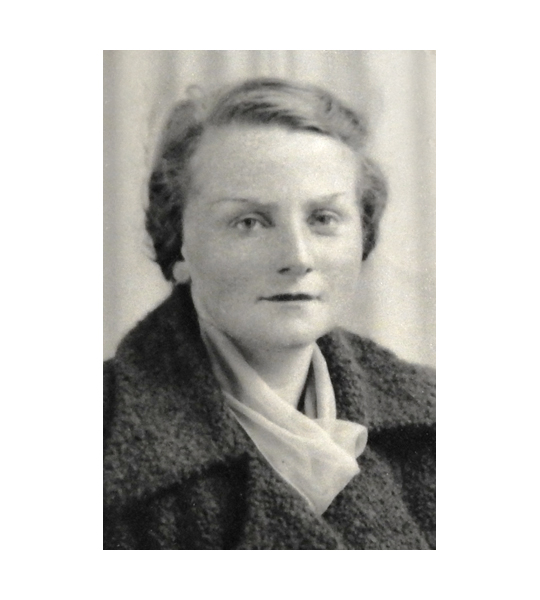
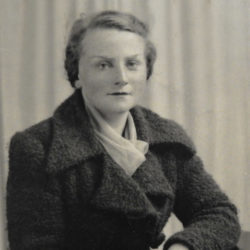
Marianne Grünfeld was born in Katowice, Upper Silesia, into a German-speaking Jewish family on 5 December 1912. Katowice was at that point and is now part of Poland. She was born to Małgorzata Margarete Grünfeld née Öttinger and Hugo Grünfeld. Her niece Janina Gering née Grünfeld-Weingrun emigrated with her parents to Romania and survived, eventually emigrating to Durban, South Africa. Marianne’s brother Walter later published his memoirs under the title Rückblicke [Looking Back], which is available online.
Marianne Grünfeld came to England in 1937 to study horticulture at Reading University. About this period of her life, her brother later wrote:
Marianne visited us at Christmas. After being invited to the Brahams’ and taking language courses in England, she had found an au pair position with the elderly, childless couple Dr. Kidd, he a natural scientist, whose work also involved agriculture, and they became very good friends. This led to her studying horticulture at the University of Reading, so she had no difficulties staying in England during that time. She was worried about what would happen afterward. She had been encouraged to emigrate to New Zealand, or, if we could help her financially from Katowice, she wanted to buy a small plot of land in England, from which one could make a good living with hard work. Her parents, she said, could then join her if Hitler attacked us as well. The Kidd couple wanted to adopt her; how would Father react? I thought it was wrong to do that to him. Of course, that was completely wrong. She also wanted to be baptized, which suited her inclinations anyway, unlike Lotte and I, never had a positive relationship with her Jewishness.
Poor Marianne, the gravity of our situation hadn’t been properly grasped. Now I know: everything should have been set in motion, everything else put aside, and an attempt should have been made to free up the money for her to run the small garden restaurant and transfer it to her in England, and they should have advised her to be adopted by the Professor Kidds. As I took her to the train station to say goodbye, she told me that Father had said to her that they probably wouldn’t see each other again. He sensed it, and perhaps understood it much better.
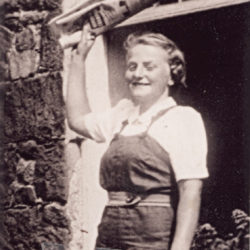
In 1939, on completion of her studies, after responding to an advertisement in an agricultural journal, Grünfeld obtained employment at Duvaux Farm in Guernsey, the home of Edwin (‘Ted’) Ogier, a former member of the States of Guernsey (the island’s parliament).
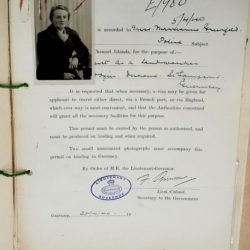
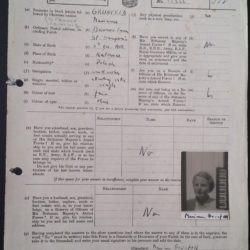
Grünfeld’s file in the Aliens’ register at Guernsey Archives shows that she was registered in the island on 20 April 1940 to be employed as a land worker, attending cattle. Grünfeld was Jewish but she did not register as a Jew in accordance with the First Order relating to Measures against the Jews, registered in the Royal Court of Guernsey on 23 October 1940. She was, however, later uncovered as a Jew. In faint pencil, the Register of Employed Aliens includes the words ‘internee (?) Jewess’ in the final column headed ‘remarks’. When this was added is unclear although the handwriting appears to be the same as the person who registered her and the handwriting changes post-war. It has been suggested that Marianne was denounced, but little concrete evidence has been found to support this hypothesis, unless the Aliens Officer denounced her. Alternatively, she may have been identified from her surname or her presence on a list of aliens, although on many records Grünfeld is spelled Grunfeld; perhaps this was Marianne’s attempt to make her name look less German or conspicuous.
On 17 April 1942, Marianne Grünfeld was interrogated by the German authorities for the second time in 12 months. She was warned, this time, to get ready for deportation. Ted Ogier, her employer, tried unsuccessfully to appeal, obtaining a letter of introduction to the Feldkommandantur from John Leale, the President of the Controlling Committee. The Reverend Douglas Ord, who kept a diary during the German occupation of Guernsey, noted on 18 April 1942 that ‘a friend [presumably Ogier] stopped me outside Grand Lodge, the Civilkommandantur [sic] to vent his rage and sorrow. He had gone to appeal for a girl employee who is only just within the forbidden degrees of Jewish birth and is to be carried off. The officials listened to the arguments but were powerless to resist the inhuman decree of the Nazi Frankenstein.’
Therese Steiner, Auguste Spitz and Marianne Grünfeld were deported to France on 21 April 1942. On their arrival they were expected to find their own accommodation. There is some confusion and competing accounts as to what happened to the three Jewish women before they were rounded up, but it seems that by 4 June 1942 they were all living in Laval (c. 140km from St Malo, where they had arrived in France), at the Hospice Saint-Louis, run by an order of nuns. Steiner found employment with the nuns as a nurse, but Grunfeld and Spitz were unemployed and in the care of the nuns.
The Jewish Star Order came into effect on 7 June 1942 and all three women were compelled to wear them. On 15 July, Therese Steiner and Auguste Spitz were arrested in Laval; Marianne Grünfeld was arrested the following day. They were taken first to Angers where the testimony of a survivor recalled that those rounded up were deprived of their possessions and herded into the small rooms of a seminary, 25 to 30 to a room, and locked in. On the day of their deportation, 20 July 1942, they were taken by lorry to the railway station. At 8.35pm, the three Jewish women were among the 824 Jews loaded into the cattle trucks of convoy No.8. The train was routed via Drancy, where 28 Jews were unloaded due to complications over establishing their nationality, and arrived at Auschwitz-Birkenau Concentration Camp on 23 July. We do not know how long Therese, Auguste and Marianne survived; eyewitness testimony regarding the occupants of convoy No.8 varies.
Her brother wrote in his memoirs about the post-war period:
I hadn’t heard from Marianne; it was now five months after the end of the war in Europe, and she was probably no longer alive. Had anyone, against all odds, still hoped? There were, after all, a few survivors who had managed to hide. Then her colleague, Mary Edwards, wrote from her workplace in Guernsey. Marianne had written to her after her deportation from France in 1942; she had been deported from the Drancy transit camp to Auschwitz in August 1942. Such a tragic twist of fate, from the English Channel Islands to this place of horror, so close to her home, where she had been born and raised, and we had all been gone for a long time.
Neither Therese Steiner, Marianne Grünfeld nor Auguste Spitz survived the war. Of convoy No.8, 18 men and two women survived.
A radio documentary was made by BBC Radio Guernsey for Holocaust Memorial Day 2016 to commemorate the three Jewish women deported from Guernsey; it can be listened to here.
In July 2024, Marianne Grünfeld was honoured with a Stolpersteine (‘stumble stone’) memorial stone, laid by German artist Gunter Demnig. This memorial stone was laid outside the home from which she was deported and an image of it can be seen on this page.
Information taken from Cohen (2000) and International Tracing Service records.
Sources
Marianne Grunfeld, Occupation Registration Form, Guernsey Archives.
Marianne Grunfeld, Aliens’ registration file, Guernsey Archives.
Cohen, F. 2000. The Jews in the Channel Islands during the German Occupation 1940-1945. Jersey: Jersey Heritage Trust.
ITS files from the Wiener Library for the study of the Holocaust and Genocide, references: 23615639, 52752958, 91054352, 107903805.
 Concentration camp
 Forced labour camp
 Internment camp
 Prison
 Other
Other